



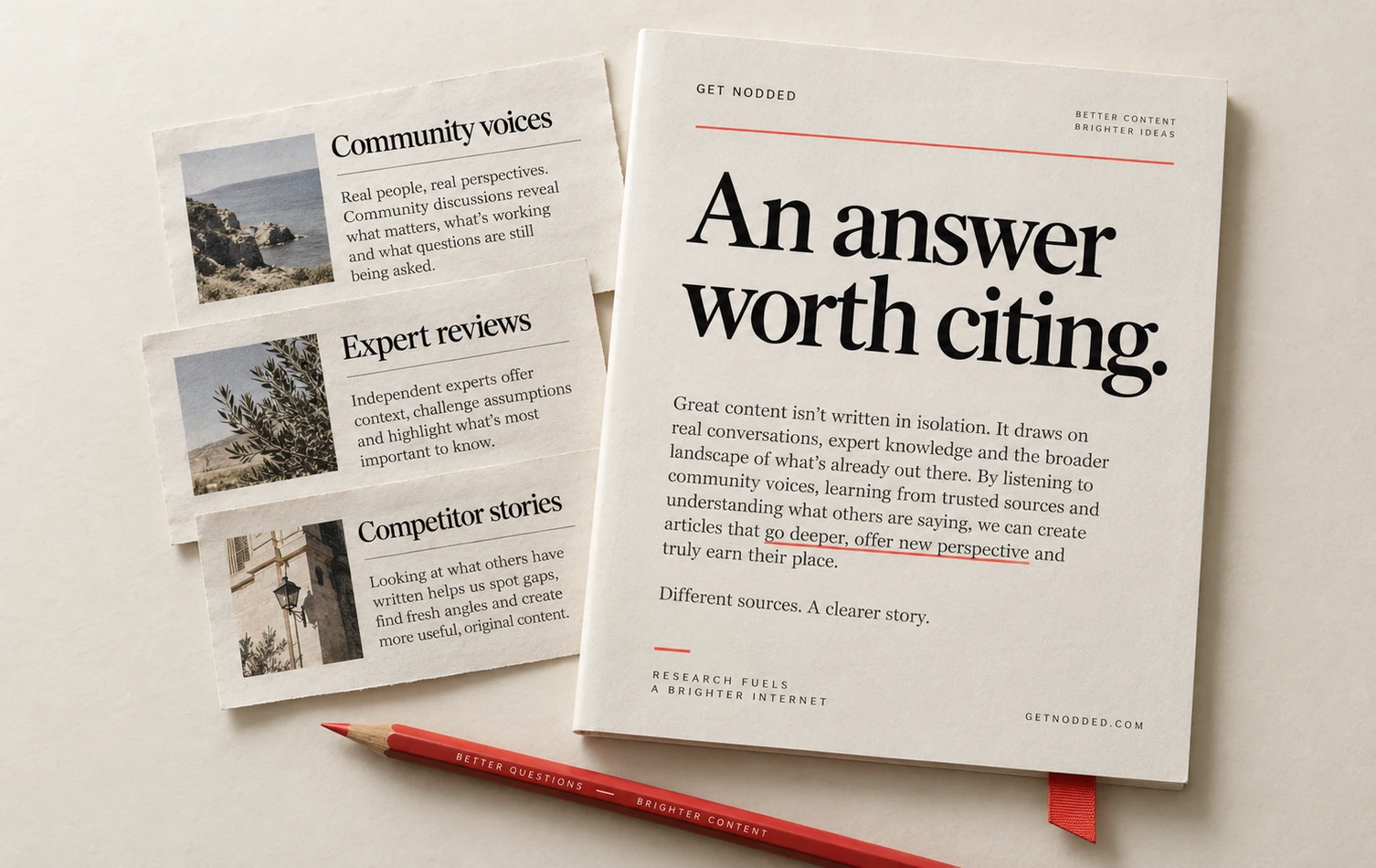
A useful article starts with a real question and research you can check. By reading the sources AI cites, listening to community questions, and studying what competitor content leaves unanswered, you can build a clearer, more helpful answer. This guide shows how to bring those inputs together with Get Nodded.
Start with a question worth answering
Choose a question your audience is already asking. Sales conversations, support requests, and the prompts you track in Get Nodded can show where people need a clearer explanation. Give each article one useful job: explain a process, compare options, or help someone make a decision.
Read the tracked AI responses for that question. Note what they explain, which brands they mention, and which sources they cite. These observations give you a research starting point; they do not tell you everything a reader needs.
Follow the sources behind AI answers
Open the cited pages instead of relying on the short description in an AI response. Check who wrote each source, what evidence it provides, and whether the details are current. A citation shows that a page was referenced in that answer; you still need to assess its accuracy.
Use Get Nodded’s citation view to find pages and domains that recur in your tracked answers. Build a short research list from the sources most relevant to your topic, then follow factual claims back to original documentation or research where possible.
Use official documentation for product capabilities and setup instructions.
Read independent reviews for practical experiences and tradeoffs.
Treat community discussions as clues to questions and frustrations, and verify factual claims separately.
Learn what competitor content leaves unanswered
Read the competitor pages that address the same reader question. Look at their examples, explanations, and supporting evidence. Notice what helps a reader decide and where the advice becomes too general to use.
Turn those observations into questions for your own research. Does the reader need a real setup example, a clearer comparison of limits, or an explanation for a smaller team? Use your own product knowledge and experience to answer those questions. The aim is to add useful information, rather than repeat another article’s structure and claims.
Bring your research into one clear brief
Before drafting, write down the reader’s question, the main answer, and the evidence needed to support it. Keep source links next to the claims they support so an editor can check them later.
For example, an article about choosing an AI visibility tool could explain prompt selection, response review, and citation analysis. Include an example of how a team would use those features, then make the relevant limits and tradeoffs clear.
Define who the article is for and the decision it should help them make.
List the questions existing sources have not answered well.
Add original examples, verified facts, and links to supporting evidence.
Create a useful article and check every claim
Lead with a direct answer, then develop it with concrete examples and clear explanations. Use descriptive headings so readers can find the part they need. Cite the source that supports each factual claim and distinguish your own observations from established facts.
Get Nodded’s AI Content tools can turn visibility gaps into article topics and produce drafts researched with live Google Search. Review the draft’s sources, product details, and recommendations before publishing. Add your own experience where it makes the explanation more helpful.
Return to the question after publishing
Keep a record of what you published and which reader question it addresses. Revisit the same tracked prompts to see how answers, mentions, and citations change over time. Review feedback from readers alongside those observations.
Refresh outdated examples, fix unsupported claims, and expand explanations that still cause confusion. AI answers vary across engines and runs, so a single change is not proof of an article’s impact. Look for recurring patterns as you decide what to improve next.
Take your first look with Get Nodded
Choose one reader question, review the sources behind the answers, and find one useful detail that existing content is missing. Use that research to create an article with a clear purpose and evidence your readers can follow.
Explore AI Content or take the product tour to see how it works.
Start creating better content